Hikula builds practical water and board gear for people who actually use it — paddles that float when you drop them, packrafts constructed from the same 210D/420D TPU denier class as rafts at twice the price, roof rack pads engineered for the aero crossbars most generic pads slide off of. Across 13 products and 9 categories, the lineup covers everything from emergency dewatering on a swamped kayak to storing a full quiver of surfboards on a single wall rack — with an average rating of 4.5 stars across the core lines.
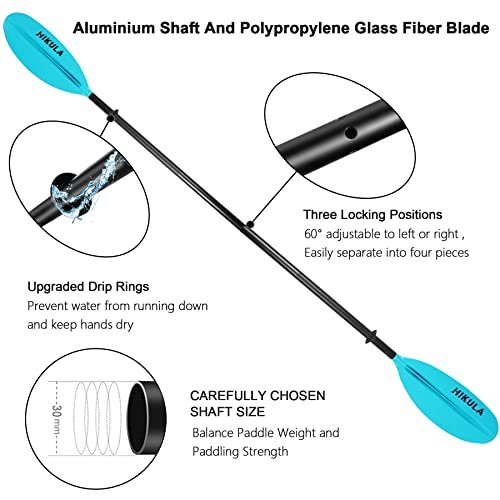
An internal seal design across the Hikula kayak paddle line keeps both the 3-piece and 4-piece models buoyant — no leash required, though you should still use one.
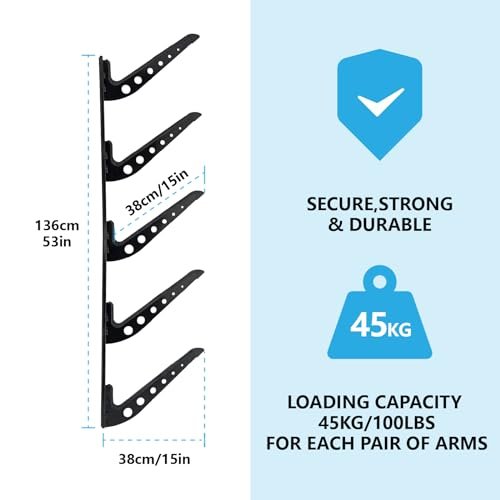
The 5-board wall rack uses powder-coated steel arms rated to 45kg (99 lbs) per pair — enough to hold a full quiver of surfboards, wakeboards, and snowboards without flexing.
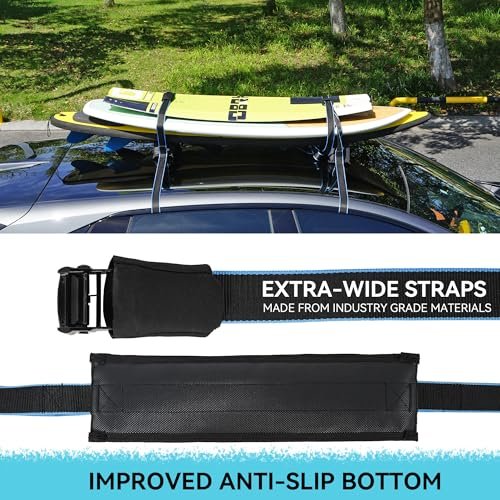
Hikula's roof rack pads use heavy-duty velcro to hold the pad stationary on the bar, plus silicone-covered metal cam buckle straps to lock the load — both working together, not as alternatives.
The manual bilge pump — #43 in Boat Bilge Pumps with 197 Amazon ratings at 4.5 stars — removes roughly 1 gallon per 2–3 strokes at a tested 20 GPM flow rate.
Hikula's lineup runs from the water to the garage wall: kayak paddles and packrafts for the paddling side, roof rack pads and the surfboard roof rack for transport, wall racks and the floor-standing beech wood stand for storage, the inflatable floating ring for lake days, the manual bilge pump for safety, and a custom-fit air mattress for Tesla Model Y owners who camp in their cars. Every category ships with the hardware or accessories you actually need — no separate purchases required to get started.
An 8-foot or 10-foot PVC ring with a 6-foot mesh center that keeps you half-submerged on a hot afternoon. Four-panel construction with double-layer hand-stitched seams, rated to 500 lbs, with a collapsible ladder and cup holders included.
Powder-coated steel, 5-board capacity, adjustable arms rated at 45kg (99 lbs) per pair. Works for surfboards, wakeboards, and snowboards — all mounting hardware ships in the box.
A floor-standing beech wood stand for displaying a single board vertically without drilling any walls. Black velvet arm padding protects rails, and the arms adjust to fit boards from 9.4 to 22 inches wide.
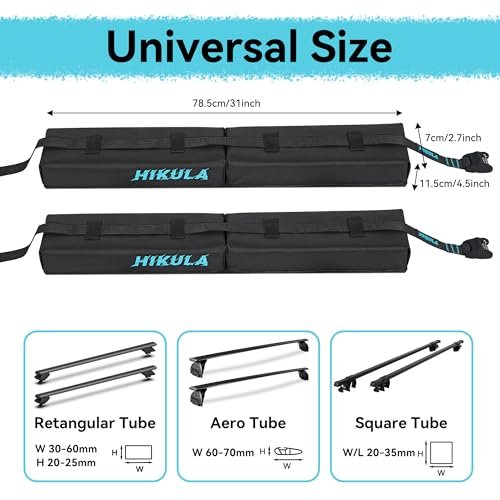
Two sizes — 28 inches (designed for aero-profile crossbars) and 31 inches (broader compatibility). Both use 600D oxford fabric with anti-UV coating and include 15-foot cam buckle tie-down straps plus bow and stern ropes.
A strap-over-roof soft rack that works without crossbars or side rails — just lay the pads across your roof, run the straps through the doors, and carry up to 3 boards. Installs in under 5 minutes on any vehicle.
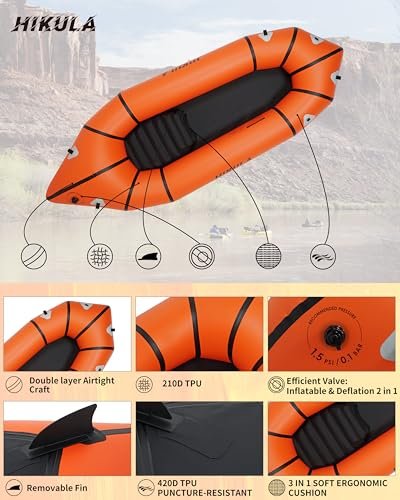
210D TPU sides and a 420D TPU floor — the same denier class used in packrafts at twice the price. Built for flatwater crossings, calm rivers, and bike-rafting, with honest disclosures about what it doesn't cover.
Drop-stitch construction custom-fit to the Tesla Model Y interior, inflates in about 2 minutes via the included manual pump, and holds up to 500 lbs. Available in orange and white; folds into a carry bag when not in use.
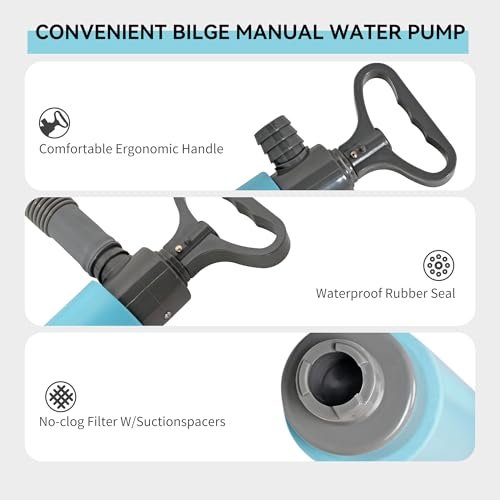
A 16.5-inch hand pump (extends to 25 inches) with a reversible 2-way hose connection, rubber seals, and a foam grip. Sized for kayak and canoe emergency dewatering, not for larger vessel bilges.
Aluminum alloy shaft with fiberglass-reinforced PP or nylon blades — both models float if dropped and break down to 3 or 4 pieces for trunk storage. The 3-piece adjusts from 220–240cm; the 4-piece comes in fixed 220cm or 230cm lengths.
These are the products that consistently collect the most reviews and the highest ratings across the Hikula catalog — not because they're the cheapest options in their categories, but because they solve a specific problem well: a paddle that floats and doesn't require a $100+ upgrade to be functional, a packraft that gives you a legitimate entry point into the activity without the premium brand commitment, and roof rack pads that actually fit modern factory crossbars. The lineup below spans eight of Hikula's nine categories.
Both Hikula kayak paddles use aluminum alloy shafts with an internal seal design that keeps them buoyant — a practical feature that matters the first time you drop your paddle mid-stroke on a lake crossing. The 4-piece model pairs the aluminum shaft with fiberglass-reinforced PP blades and comes in fixed 220cm (86.6 inches) or 230cm (90.5 inches) lengths. The 3-piece uses nylon blades and adjusts anywhere from 220 to 240cm (86–94 inches), which makes it a better fit if you're sharing the paddle between paddlers of different heights or switching between kayak widths.
The right paddle length depends on two numbers: your height and your kayak's width. A paddle that's too short forces you to drop your upper hand too low, which kills power on the recovery stroke. Too long and you're over-reaching on every stroke, which wears out your shoulders faster than the distance does. For most recreational paddlers in a standard 24–28 inch wide kayak, 220cm works well up to about 5'10" and 230cm covers taller paddlers and wider boats from about 5'11" up.
The 4-piece Hikula paddle (B09Q94K99Z) comes in fixed 220cm (86.6 inches) and 230cm (90.5 inches) lengths — you choose at checkout, so it's worth confirming before you order. The product listing notes the 230cm length fits most paddlers over 5'5" with a kayak width of 24–28 inches, which covers the majority of recreational sit-inside and sit-on-top kayaks. If you're paddling a wider inflatable or touring kayak — anything over 28 inches across the cockpit — go with 230cm regardless of your height. The extra length compensates for the wider reach needed to clear the hull cleanly on each stroke.
The 3-piece model (B0CGHLQPWL) adjusts anywhere between 220 and 240cm via snap-button ferrule, which solves the sizing question outright if two people of different heights are sharing the paddle or if you paddle multiple kayak types. That flexibility is genuinely useful — not a marketing claim. It also means you can dial the length in over a few sessions rather than committing to a fixed number before your first time on the water.
Here's the honest version of this comparison. Both blade materials are aluminum-shafted recreational paddles — they're not competing against Werner or Aqua-Bound carbon. What they're competing against is the sub-$30 injection-molded paddles that flex mid-stroke and don't float.
Both models float. That's not a minor spec — it's the reason experienced paddlers on r/Kayaking consistently recommend floating paddles even at the budget tier. An internal seal in the aluminum shaft keeps the paddle at the surface if it leaves your hands. Neither model requires a paddle leash, though using one is still good practice on open water.
Both Hikula paddles offer ±60° blade angle adjustment via the snap-button ferrule. Feathering reduces wind resistance on the upper blade during the recovery stroke — useful in headwinds, less relevant on calm days. There's no universally correct angle. Some paddlers paddle unfeathered (0°); others swear by 45° or 60°. Set it to whatever feels natural after your first few outings and don't overthink it. The snap-button makes it easy to change if your preference shifts.
Hikula's packrafts are built from 210D TPU on the sides and 420D TPU on the floor — the same denier class used in packrafts at significantly higher price points. The 235cm orange model weighs 6.6 lbs (3.0kg) and handles a 330 lb max load; the green variant comes in at 2.6kg packed weight with the same TPU construction and an included inflatable seat and carry bag. Neither model has a spray deck or self-bailing floor — which matters if you're planning Class III+ whitewater. For flatwater crossings, calm river travel, and bike-rafting approaches, the construction is legitimate.
The core question people ask before buying a Hikula packraft — and it comes up directly in r/packrafting threads — is whether the 210D TPU construction is genuinely comparable to what Alpacka and Kokopelli use, or whether the denier number is just marketing on a cheaper product. The honest answer sits somewhere in the middle, and it's worth unpacking exactly where the similarities end and where the gaps begin.
Denier measures the linear mass density of the fabric fiber — in practical terms, higher denier means heavier and more abrasion-resistant material. The Hikula packraft uses 210D TPU on the sides and 420D TPU on the floor (B0DZCPZDXT). Kokopelli's rafts use 1000D reinforced PVC on sides and drop-stitch fabric on the floor. Alpacka uses 840D nylon with TPU coating on the Caribou and higher-end models.
The r/packrafting community thread that directly names Hikula makes this point well: the construction is legitimate at the denier level, but the packraft doesn't have a spray deck or self-bailing floor. Those two features — not the fabric — are the real distinguishing line between Hikula and premium boats for moving water use.
The arrow-shaped hull increases forward tracking compared to a symmetrical oval design — it paddles more like a kayak and less like a pool toy on flatwater. The inflatable soft seat provides reasonable comfort for 1–3 hour flatwater sessions. At 6.6 lbs packed for the 235cm orange model, it fits in a backpack alongside a day's worth of gear, which is the whole point of packrafting in the first place. Bike-rafting approaches work well — deflate at the put-in, inflate in a few minutes with a breath or inflation bag, cross the river, deflate and pack again.
Mountain lakes, calm rivers with moderate current, flatwater crossings on multi-day backpacking routes — these are the conditions where the 210D/420D construction performs as advertised. The 330 lb max load leaves room for a loaded backpack and light gear alongside the paddler on the 235cm model.
Two features are absent from both Hikula packraft variants, and neither is a minor detail:
If your planned use is Class III or above, spend more. The Kokopelli XPD starts around $749 and includes features that make a real safety difference in technical water. For the paddler who wants to try packrafting on flatwater lakes and calm rivers without committing $750+ to find out if the activity is for them, the Hikula packraft is a legitimate entry point — not a compromise.
The 235cm orange model (B0DZCPZDXT) is the more detailed listing with the higher current rating (4.8/5 across 9 reviews). It specifies 6.6 lbs (3.0kg), 330 lb max load, an upgraded air valve, and the arrow-shaped hull design. The green variant (B0C49N58QB) lists a packed weight of 2.6kg with the same 210D/420D TPU construction and includes an inflatable seat and carry bag. Both are the same core boat. Check current Amazon availability on each — the orange 235cm is the newer listing and has the most detailed spec documentation of the two.
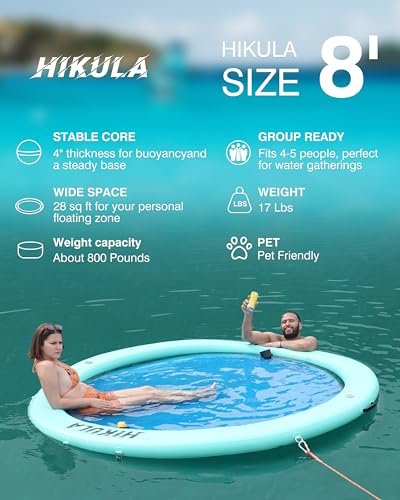
The Hikula floating ring isn't a standard pool float — the 6-foot stretchable mesh center keeps you half-submerged in the water rather than sitting on top of it, which makes a real difference on a hot afternoon. The outer ring is built from four PVC panels bonded with industrial-grade seals and double-layer hand-stitched seams, rated to 500 lbs and sized to hold 2–4 people. At 20 lbs total, it's portable enough to carry solo to a lake or campground. The collapsible water ladder and submerged cup holders ship in the box — nothing to add on separately.
The Hikula floating ring sits in a category that Sunchill essentially created for the consumer market — a large inflatable ring with a mesh center that keeps you half-submerged rather than perched on top of a solid float. Because Sunchill built the search demand for this product type, "Sunchill dupe" and "Sunchill knock off" are among the most active autocomplete terms in the category. That context is worth addressing directly before anything else.
This is the feature that justifies the entire category. On a standard pool float — foam mat, inflatable lounge, solid raft — you're lying on top of the water. The mesh center design suspends you just below the water's surface, so on a 90°F afternoon, the water temperature is doing the cooling work rather than the sun bouncing off a hot vinyl surface. You're lying in the water, not on it. Four adults can stretch across the 6-foot mesh simultaneously on the 10-foot ring. The outer inflated ring keeps you stable; the mesh does the rest.
The elastic rope system controls how deep the mesh sinks — the Hikula ring ships with the knot loosely set so you can adjust it to your preference before first use. This is a deliberate design choice, not a quality control miss. A tighter knot keeps the mesh shallower; a looser knot lets it sink deeper for more water contact. Worth setting before you inflate the first time.
Sunchill uses proprietary Carbon-Wave PVC, which is their branded term for the heavy-gauge PVC construction that distinguishes their product from standard pool float material. It's a legitimate differentiator — Sunchill's ring is built to a higher material standard than most competitors and prices accordingly.
The Hikula ring uses four-panel heavy-duty PVC bonded with industrial-grade seals and double-layer hand-stitched seams. The hand-stitching at the seams is the construction detail that separates it from single-layer welded pool floats that delaminate after one summer of UV exposure. Four-panel construction also distributes inflation pressure more evenly than a single-chamber design, which is why it holds 500 lbs without the outer ring distorting under load.
The 8-foot ring has a 6-foot mesh center and comfortably holds 2–3 adults within the 500 lb total capacity. It weighs 20 lbs deflated and fits in a truck bed, SUV cargo area, or large duffel for transport. The 10-foot version gives meaningful additional room for 3–4 adults — the larger outer ring provides more buoyancy margin and the mesh center has more usable surface area.
Choose 8 feet if you're using it primarily as a couples float or with one or two kids. Choose 10 feet if you're outfitting a group of four adults or want more float-around room. Both sizes include the collapsible water ladder and submerged cup holders — nothing additional to purchase for either configuration.
Pools, lakes, and calm coastal water are the right environments. The ring is not designed for open ocean surf, rivers with significant current, or conditions with sustained wave action. The mesh center sits at or below the water surface — in chop, that means water comes through the mesh more actively. For a calm lake afternoon, that's irrelevant. In ocean surf, it's a reason to leave this ring at home and rent a paddleboard instead.
Storage note: rinse with fresh water after salt water use, deflate fully before long-term storage, and keep it out of direct UV when not in use. The PVC construction is UV-resistant but not UV-proof — the same applies to every float in this category.
The Hikula 5-board wall rack uses powder-coated steel arms rated to 45kg (99 lbs) per pair — enough load capacity for a full quiver of surfboards, wakeboards, and snowboards on a single mount. Arms are adjustable to accommodate different board widths and thicknesses, and durable rubber padding at every contact point protects board rails and fins from scratches during storage. Mounting hardware (screws, anchors, washers) ships in the box; no separate hardware trip required. Rated #7 in Amazon's Indoor Surfboard Storage category with 91 reviews at 4.4 stars.
The most common question in r/surfing threads about wall rack sizing — and the question that generates the most returns in this category — is whether a specific rack will actually hold a 9-foot longboard without the arms being too narrow or the weight rating falling short. The Hikula 5-board wall rack (B0CWG8ZB2X) has specific answers to both questions, and they're worth knowing before you start drilling holes.
The arms on the Hikula wall rack are adjustable, which is the key feature that separates a genuine multi-board rack from a set of fixed hooks. A standard shortboard (5'8"–6'4") sits comfortably on arms spaced at a narrower setting. A 9-foot longboard — which runs 18–22 inches wide at its widest point — needs the arms spread to at least that width to cradle the board without resting on the rails.
The arms accommodate boards from shortboards through 9-foot longboards. Before mounting the wall rails, decide which board you'll load first and space the arms to match its widest measurement. Because the arms attach to the rails without requiring tools, you can reposition them later if your quiver changes — no new holes in the wall.
Each pair of arms is rated to 45kg (99 lbs). A standard shortboard weighs 5–8 lbs. A longboard runs 12–18 lbs. A wakeboard or snowboard adds another 6–12 lbs. Five boards of mixed types — say, two shortboards, one longboard, one wakeboard, one snowboard — will total somewhere between 35 and 65 lbs across two to three arm pairs. That's well within the per-pair rating. The steel construction handles the weight; the question is always whether the wall anchors do, which brings up the next point.
The rack ships with screws, anchors, and washers for standard drywall installation. For concrete or masonry walls — common in garages with poured concrete construction — the included anchors may not be appropriate. Concrete requires masonry-specific anchors (sleeve anchors or wedge anchors rated for the load), which are available at any hardware store. The rail span across the wall determines the anchor spacing; wider rail placement distributes the load more evenly and reduces stress on individual anchor points.
One practical note from r/surfing threads: people storing longboards specifically sometimes ask whether to hang the board horizontally or lean it. The wall rack holds boards horizontally — fins facing the wall — with the rubber arm padding protecting the deck from contact marks. This is the recommended orientation for long-term storage because it removes gravitational stress on the stringer from the board's own weight.
The 5-board configuration doesn't require 5 boards to be useful. Many buyers mount the rack initially for 2–3 boards and add boards to the quiver over time without needing a new rack. Because the arms adjust without tools, reorganizing the spacing as your board collection changes takes a few minutes. If you're storing only one board and want a display-focused option rather than a utility storage rack, the Hikula Surfboard Stand Beech (B0D2RGVRXC) is worth considering — it's a floor-standing vertical stand that holds a single board with black velvet arm padding and no wall drilling required.
The Hikula surfboard stand is a floor-standing vertical rack made from beech wood uprights with a chamfered and polished finish. Black velvet padding on the arm rests protects board rails without the compression or slippage you get from foam strips on cheaper stands. No wall drilling — it stands freely and can be moved without leaving holes. Arms adjust to fit boards from 9.4 to 22 inches wide, which covers shortboards, fish, and longboards up to standard width. At 9.55 lbs, it's light enough to reposition without effort.
Most generic roof rack pads are designed for round or square crossbars — they shift, slip, or sit unevenly on the flat blade-shaped aero bars that come standard on Thule, Yakima, and factory OEM systems. Hikula makes two pad sizes specifically to address this: the 28-inch model is built for aero-profile bars (roughly 2 to 2.875 inches wide), and the 31-inch model covers a broader range of crossbar types. Both use 600D oxford fabric with anti-UV coating and close with heavy-duty velcro plus silicone-covered metal cam buckle tie-down straps — the velcro holds the pad in place on the bar; the straps secure the load on top.
The single most common installation problem with roof rack pads — documented across multiple r/surfing threads and every negative review in this product category — is using round-bar pads on aero-profile crossbars. They don't seat flat. They rotate. At highway speed, a pad that's shifted 30 degrees off-axis puts your board against the buckle hardware rather than the foam, which is exactly what you're trying to avoid. The fix is straightforward: identify your crossbar profile before you order.
Look at your crossbars from the front of the car. Round bars have a circular cross-section — the pad wraps around the full circumference. Square bars are similar but with flat sides. Aero bars are blade-shaped: flat on the top and bottom, with tapered edges, typically 2 to 2.875 inches wide across the flat face. Aero bars are standard on modern OEM factory roof rack systems from Thule, Yakima, and most current-model factory crossbars from Toyota, Subaru, Honda, and similar manufacturers.
If you're not sure which type you have, measure the crossbar at its widest point. A measurement between 2 and 2.875 inches indicates an aero-profile bar. Under 1.5 inches is likely a round bar. The measurement also tells you which Hikula pad fits.
Reddit's r/surfing threads ask this question constantly: "Are rack pads reliable enough to go 80 mph with?" The answer depends on the closure system. Velcro-only pads can shift on smooth aero bars at highway speed because there's no mechanical lock holding the load — just adhesion. The Hikula closure uses two components working together, not as alternatives.
The heavy-duty velcro wraps the crossbar and holds the pad itself in position — it prevents the pad from rotating or sliding along the bar. The silicone-covered metal cam buckle straps (two 15-foot straps included with both models) go over the boards and cinch down to secure the load on top of the pad. Silicone coating on the buckle housing protects paint and board surfaces at the contact point. Tighten both straps evenly and the load doesn't move — the velcro handles pad positioning; the cam buckles handle load restraint.
One installation note: route the straps through the vehicle doors rather than windows, loop them around the crossbar, and thread them back through the cam buckle. Pull firm tension on both straps before closing the doors. If the boards produce a buzzing sound at speed, the strap has gone slack or is vibrating — pull over, re-tension, and give each strap a half-twist before the cam buckle to dampen vibration at highway speeds.
The Hikula surfboard roof rack is a strap-over-roof soft rack — you don't need crossbars, side rails, or any existing roof hardware. Two foam pads lay across the roof (one above the front seats, one above the rear seats), and the straps loop through the open door frames to cinch down. Extra-wide 1.5-inch straps with silicone-coated buckles protect board surfaces and car paint from scratch damage. Holds up to 3 boards — surfboards, SUPs, and paddleboards in socks or board bags included — on any vehicle from a coupe to a full-size SUV. The whole system weighs 3.28 lbs and sets up in under 5 minutes.
The Hikula surfboard roof rack (B0F65D3B14) is a strap-over-roof system — it doesn't require crossbars, side rails, gutters, or any modification to your vehicle. This matters because a lot of the surfboard transport conversation on r/surfing assumes you already have a crossbar-mounted rack system. If you don't, this is the cleaner starting point: two foam pads, four straps, and five minutes to load and go.
The installation sequence matters. Do it out of order and you'll be pulling straps back through closed doors.
The rack handles up to 3 boards — surfboards, SUPs, paddleboards in board bags or socks. A common two-board load is a 9-foot longboard on the bottom with a shortboard on top. The 1.5-inch wide straps are broader than most competing soft rack systems, which distributes pressure more evenly across the board deck and reduces the risk of compression marks on softer foam tops.
Stacking boards: put the heavier or longer board directly on the pads and the lighter board on top. Alternate fin placement (fins on opposite sides) when stacking two boards to avoid pressure points where one fin contacts the other board's deck.
A vibrating buzz at highway speed is almost always a loose or straight strap. Two fixes work reliably. First, check strap tension — pull both straps to the same firm tension before the buckle. Second, give each strap a half-twist before threading it through the cam buckle. The twist breaks up the flat surface that resonates in wind and eliminates the buzz without reducing holding strength. This applies to both the door-frame straps and the board tie-down straps.
Honestly: if you're surfing 3+ days a week and loading boards every session, a crossbar-mounted system (or the Hikula roof rack pads on your existing crossbars) is more convenient long-term. Strap-over systems take 5 minutes to install correctly and 3 minutes to remove — that's fine for occasional use or rental car trips, but it adds up if you're doing it every day. The Hikula Aero Rack Pads 28" (B09TPGCNQH) or Roof Rack Pads 31" (B0DHK4L457) are the next step up if you have crossbars and want a faster loading routine.
The Hikula manual bilge pump is a 16.5-inch hand pump (extends to 25 inches with the hose) built for emergency dewatering on kayaks, canoes, and small dinghies. The reversible 2-way hose connection lets you switch between intake and discharge direction without removing anything from the pump — a detail that matters when you're ankle-deep in a swamped cockpit and working one-handed. High-quality rubber seals tested at 115 cubic inches per stroke remove roughly 1 gallon per 2–3 pumps at a 20 GPM flow rate. At 0.78 lbs, it fits in a cockpit hatch or paddle float dry bag without taking up meaningful space.
A bilge pump is one of those pieces of gear that sits unused for months and then earns its space in the cockpit hatch in about 90 seconds. The Hikula manual bilge pump (B0DG5CVKSC) removes roughly 1 gallon per 2–3 strokes at 20 GPM — enough to clear a swamped kayak cockpit in under 3 minutes under normal conditions. That number is worth knowing before you need it.
Three scenarios put a bilge pump in use on a kayak or canoe:
The 2-way attachment on the 41.3-inch hose is the most practically useful feature on this pump. Standard bilge pumps have a fixed intake end (the end that goes in the water) and a fixed discharge end (where the water exits). The Hikula pump allows you to flip the hose connection — intake becomes discharge and vice versa — without removing anything from the pump body. This matters when you're working one-handed in a swamped cockpit and need to redirect flow without stopping to reconfigure the pump. Practice the flip before you're in conditions where it matters.
The 17-inch model (this one, at 0.78 lbs with a 41.3-inch hose) is sized for kayak and small canoe use. It fits in a cockpit hatch, clips to a deck line via the handle, and doesn't add meaningful weight to the kit. The 19.7-inch version is heavier at 1.2 lbs and designed for larger vessels — dinghies and small open boats where more pump stroke volume is useful.
For a sea kayak or recreational sit-inside kayak, the 17-inch is the right tool. The larger model offers more volume per stroke but requires more storage space and is awkward to operate in a confined cockpit. If you paddle a canoe or an open-cockpit boat and want faster dewatering, the 19.7-inch pump makes more sense.
A hand bilge pump for a kayak is not the same tool as a mounted diaphragm pump on a sailboat. The Hikula pump is rated for small craft emergency dewatering — kayaks, canoes, dinghies. Using it to bail a 30-foot sailboat bilge is like using a garden hose to fight a house fire: technically possible, practically insufficient. If your vessel needs a high-GPM mounted pump, that's a different product entirely.
Rinse the pump with fresh water after every salt water use — the rubber seals deteriorate faster in unrinsed salt exposure. The seals can stiffen in cold water (below 45°F) but remain functional. A small amount of food-grade silicone lubricant on the seals before cold-weather use keeps them pliable. Store the pump dry between uses with the hose loosely coiled, not kinked tight, to prevent hose cracking at the connection points.
Both Hikula Tesla Model Y air mattresses use drop-stitch construction — the same method used in paddleboards — which allows the mattress to inflate to a firm, flat surface rather than a rounded bladder shape. At 80 by 62 inches and 4 inches thick, the custom-fit dimensions fill the Model Y cargo area when the rear seats are folded flat. Both variants hold up to 500 lbs, inflate in approximately 2 minutes using the included manual pump, and fold into the included storage bag when not in use. The orange model highlights a drop-stitch design optimized for back support; the white model adds an anti-deflate dual valve.
For paddlers up to about 5'10" in a standard 24–28 inch wide kayak, the 220cm length works well. At 5'11" and above, or in a wider recreational kayak, go with 230cm. The 3-piece adjustable model covers 220–240cm and is the right choice if two people of different heights will share the paddle.
A packraft is designed to pack down to backpack size and be carried overland between water sections — typically 3–7 lbs. An inflatable kayak is primarily a water craft that collapses for storage, but not for multi-day overland carry. The Hikula TPU Packraft 235cm weighs 6.6 lbs and fits in a backpack alongside gear, which is the defining packraft use case.
Packrafts are generally wider relative to their length than touring kayaks, which gives them higher initial stability on flatwater. The tradeoff is tracking — they don't hold a straight line as efficiently as a longer kayak hull. The Hikula packraft's arrow-shaped hull improves directional tracking compared to a symmetrical round hull, but it paddles differently than a sit-in touring kayak.
The Hikula Floating Ring 8FT/10FT is rated to 500 lbs total and designed for 2–4 people. Four adults at average weight fall within that capacity. The 10-foot version provides more surface area and buoyancy margin for a full group of four; the 8-foot is more comfortable for two to three people.
Mount the wall rail horizontally at shoulder height with anchors rated for the combined board weight. The Hikula 5-Board Wall Rack ships with all hardware (screws, anchors, washers) for standard drywall. Attach arms to the rail, adjust spacing to match your widest board, and hang boards fins-facing-wall in a horizontal orientation. Remove the center tail fin before placing a board vertically.
The Hikula Aero Rack Pads 28" are designed for aero-profile crossbars in the 2–2.875 inch width range, which covers most Thule, Yakima, and factory OEM aero bars on current vehicles. Standard round or square crossbars work with either the 28-inch or 31-inch model. Measure your bar's flat-face width if you're unsure which profile you have.
Any load on the roof increases aerodynamic drag and reduces fuel efficiency — the pads themselves contribute minimally, but the boards add a meaningful profile. Positioning boards fins-forward reduces drag compared to fins-rearward. The Hikula rack pads' built-in non-slip mat reduces vibration, which doesn't affect fuel economy but does reduce noise at speed.
Yes, for small craft. The Hikula manual bilge pump removes approximately 1 gallon per 2–3 strokes at a tested 20 GPM flow rate — sufficient to clear a swamped kayak cockpit in under 3 minutes. It's sized for kayaks, canoes, and small dinghies. It's not appropriate for sailboat or powerboat bilge dewatering, which requires a mounted high-GPM diaphragm pump.
Yes. The Hikula Surfboard Roof Rack is a strap-over-roof soft rack that works on any vehicle without crossbars, side rails, or gutters. The straps loop through the open door frames to cinch down. It holds up to 3 boards and sets up in under 5 minutes. For daily surfing, a crossbar-mounted pad system is more convenient long-term.
Both Hikula Model Y mattresses are custom-fit for the Tesla Model Y interior with rear seats folded flat. The white variant is specifically listed for 2021–2024 model years. The 80×62×4 inch dimensions fill the cargo floor area; the drop-stitch construction maintains a flat, firm surface rather than a rounded bladder shape. Neither fits other vehicle models.
The Hikula 5-Board Wall Rack uses rubber padding on every arm contact point — not foam strips, which compress and can slip, but rubber that holds position while protecting board rails. For additional protection during long-term storage, some paddlers add a strip of pipe insulation foam over the arm for softer contact, particularly on glassed boards.
The Hikula Surfboard Stand Beech adjusts to fit boards from 9.4 to 22 inches wide, which covers standard longboard widths. It's a floor-standing vertical design with black velvet arm padding and holds one board at a time. Remove the center tail fin before placing the board vertically. The stand weighs 9.55 lbs and requires no wall drilling.
"I was skeptical about an aluminum-shaft paddle at this price, but the fiberglass-reinforced blades make a real difference compared to my old nylon ones — noticeably stiffer on the catch. The floating design saved me twice on a windy lake crossing when I fumbled the paddle between strokes. Only thing I'd flag: confirm your length before ordering since the 4-piece comes in fixed sizes."— Donna R., Recreational Weekend Paddler, on kayak paddle
"I've been reading r/packrafting for a year and finally bought this instead of committing $750+ to find out if packrafting was for me. The 210D/420D construction is legit — no leaks after 6 river crossings on a bike-rafting trip. No spray deck is a real limitation on Class II with wave action, just like the listing says. For flatwater and calm rivers, it's everything I needed to test the activity."— Marcus T., Budget-Curious Packrafter, on packraft
"Our group of four adults spent a full afternoon on the 10-foot ring at the lake house. The mesh center is the whole point — you're in the water, not on it. The included ladder made getting in and out easy for everyone. Seams look solid after three weekends of heavy use. Set the bungee knot before you inflate it the first time; it ships loose intentionally."— Kristin M., Family Lake Trip Organizer, on inflatable floating ring
"My Thule aero bars finally have pads that actually sit flat instead of spinning sideways. The silicone buckle straps are the right call — no paint scratches after driving two hours to the coast. Held two boards including a 9-foot longboard at highway speed without any movement. The velcro on its own wouldn't be enough for aero bars; the strap system is what keeps it there."— Jake S., Gear-Organizing Surfer, on roof rack pads
"Mounted this for a quiver of five boards — two shortboards, a longboard, a wakeboard, and a snowboard. Arms adjusted easily for each width and the rubber padding hasn't marked any of the rails. The mounting hardware worked fine in standard drywall. One thing: if you have concrete walls, buy masonry anchors before you start — the included hardware is for drywall only."— Brian L., Gear-Organizing Surfer, on surfboard wall rack
"I've carried a bilge pump for three years and finally needed it when a wave swamped my sit-inside on a coastal tour. The reversible hose is genuinely useful one-handed — I could flip intake to discharge without stopping. Cleared the cockpit in about two minutes. At 0.78 lbs it lives in my day hatch without taking up meaningful space. Not for anything larger than a kayak or small dinghy, as advertised."— Sarah K., Recreational Weekend Paddler, on manual bilge pump
Hikula started where most water sports brands start — with paddles. The kayak paddle line, now holding 193 and 153 reviews respectively across the 4-piece and 3-piece models, was the foundation: a practical aluminum-alloy shaft paddle with a floating design and fiberglass-reinforced or nylon blades, priced for people who wanted something meaningfully better than a department store oar without committing to a $150+ carbon upgrade. That positioning — honest specs, complete out of the box, no accessories required to make it functional — became the thread running through everything the brand built after it.
The expansion into packrafts followed the same logic but pushed the price point considerably further. A TPU packraft using 210D side fabric and a 420D floor isn't cheap to produce — the Hikula TPU Packraft 235cm sits at the entry end of a category where premium brands charge two to three times more. Getting there required the same material transparency the paddle line is built on: stating the denier, disclosing the absence of a spray deck and self-bailing floor, and letting buyers make an informed decision rather than hiding limitations in fine print. The roof rack pads line emerged from a specific frustration in the surfboard transport category — most pads are designed for round crossbars, and the flat-profile aero bars on modern Thule, Yakima, and factory OEM systems don't work with them. The Hikula Aero Rack Pads 28" and Roof Rack Pads 31" addressed that gap directly. The surfboard roof rack followed as a no-crossbar alternative for vehicles that don't have a rack system at all. The manual bilge pump — a safety item, not a lifestyle product — fits the "complete kit" philosophy: if you're paddling a packraft or kayak, you need one, and Hikula makes one that works.
Today the Hikula catalog covers nine categories: kayak paddles, packrafts, the inflatable floating ring, the 5-board surfboard wall rack, the beech wood surfboard storage stand, roof rack pads, the surfboard roof rack, the manual bilge pump, and the Tesla Model Y air mattress — a genuine outlier in the lineup that applies the same drop-stitch construction principle from the paddlesports world to car camping. The Tesla mattress is the clearest sign that Hikula follows its audience more than it guards a category boundary. The people buying a packraft for a bike-rafting trip are often the same people sleeping in their cars at the trailhead the night before. The brand is practical by design, specific by necessity, and honest about what each product does and doesn't do — which is the only positioning that works when your buyers are reading Amazon review threads and Reddit threads side by side before they spend a dollar.
We embedded this one because it covers the questions we hear most — blade sizing, shaft length, and how to match a paddle to your paddling style and kayak width. You'll get a clear breakdown of the fit variables that actually matter before you buy. If you've ever grabbed a paddle that felt wrong after the first mile, this is the walkthrough that explains why.
Marcus answers the questions you're actually asking before you have to dig through five Reddit threads to find the answer.
Hikula sells across nine outdoor and water sports categories — kayak paddles, packrafts, inflatable floating rings, surfboard wall racks, surfboard storage stands, roof rack pads, surfboard roof racks, manual bilge pumps, and Tesla Model Y air mattresses. Every product in the lineup ships with the accessories needed to use it immediately, without a separate hardware purchase. The full catalog is available through the Hikula store on Amazon.
Hikula customer support is handled through Amazon's messaging system — reach them directly from any product page via the "Ask a Question" or seller contact link. Response times follow Amazon's standard seller response window. For straightforward issues on arrival — damaged items, wrong size, missing accessories — Hikula's stated approach is to replace rather than dispute.
All Hikula products are eligible for Amazon's standard 30-day return window. Warranty terms are not separately published; any quality issue outside the return window is best addressed directly through Amazon's buyer-seller messaging. For questions about compatibility before purchase — particularly for the aero rack pads or the Tesla mattress model year fit — contact Hikula through Amazon before ordering.